How Much Does a Commercial Office Move Cost in Calgary?

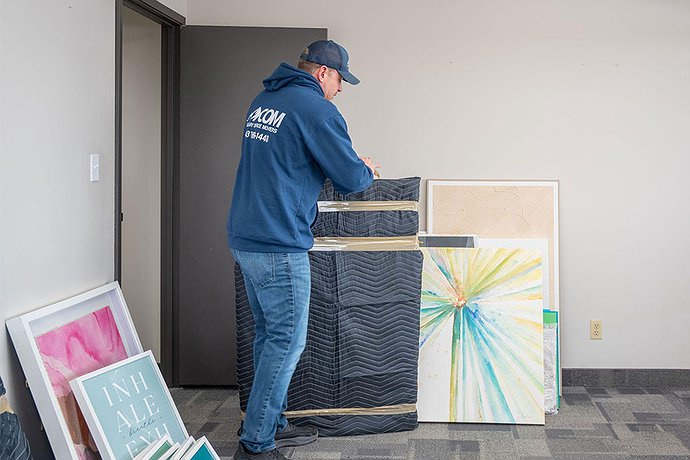
A commercial office move in Calgary is priced on crew size, hours, and building access, not on a flat fee per desk. A published Calgary band for two movers and a truck is $100 to $160 an hour, often with a two-hour minimum. A 2026 Canadian office-rate sample puts three movers and a truck at $165 to $190 an hour, and a small office of up to about 10 people at $1,000 to $2,300 before tax.
Those figures are budget screens. An office floor usually needs three or four people, not the two-person crew in a household ad, because the volume is workstations, task chairs, and filing. A 10- to 30-person office is published at $2,300 to $6,000. A larger floor, about 30 to 50 people, is published at $7,000 to $15,000, and it often runs past one evening.
The hourly number is still not the project. Travel, a dock that is only yours for two hours, packing, and IT work sit beside it. Basic liability doesn't cover replacing a server at 60 cents a pound. And an evening or a weekend is not an automatic surcharge with every company.
Key Takeaways
A small office of up to about 10 people is published at $1,000 to $2,300 for a local move, before tax. A 10- to 30-person office is published at $2,300 to $6,000.
Two movers and a truck are published at $100 to $160 an hour in Calgary. A 2026 national office sample puts three movers at $165 to $190 and four at $210 to $240.
Most office jobs are billed by the hour, not per desk. As a guide, the physical move is about $150 to $300 per employee before any IT work.
The dock window, the freight elevator, and a certificate of insurance decide whether the hourly rate is even usable.
Some markets add about 25% after hours. A company can also charge the same rate on an evening, a weekend, or a holiday. Ask which rule is on your quote.
The crew can move computers and a server room. Disconnecting and reconnecting them is a separate job and not included in this service.
In Alberta, a final bill that exceeds the estimate by more than 10%, up to $100, needs your agreement.
How much does a commercial office move cost in Calgary?
The cost of a commercial office move in Calgary is based on hours, not a single city tariff. Use the small-office row when the floor has under 10 people, and both buildings have a clear path. Use the middle row when the headcount is about 10 to 30, and the work must finish in one evening or one weekend. Use the large row when the move spans more than one day.
The 2026 national sample, updated in October 2026, makes it clear that Toronto sits near the top of each range. Calgary's published two-mover band starts lower, at $100 an hour, so a Calgary quote can land under a national middle without being a thin job. It can also land over the row once the dock, the stairs, or a second truck appears. Neither table is a quote until someone has walked both floors.
Tax sits on top. The size ranges below are published before tax. A written quote should say whether GST is inside the number.
A second truck changes the arithmetic faster than another hour does. A 20-person floor that will not fit one truck becomes two trips or a larger crew, and the published mid-size band of $2,300 to $6,000 is where that choice usually lands. Ask the walkthrough whether the load is one truck. If the answer is a guess, the hourly rate is not finished.
Published ranges by office size
Headcount is a label. Workstations, lateral filing, and a server closet are the load. Two companies with the same staff count can sit at opposite ends of a row: one with an open bench of rolling desks and the other with private offices full of case goods.
Office | Published local range | What usually sits in the job |
Up to about 10 people | $1,000 to $2,300 | 2 to 3 movers, about 4 to 8 hours |
About 10 to 30 people | $2,300 to $6,000 | 3 to 5 movers, often one evening |
About 30 to 50 people | $7,000 to $15,000 | A larger crew, often more than one day |
A middle figure on the small row is published around $1,650. Treat that as the centre of a straightforward local job, not as a promise. Files you meant to purge, a second address, or a workstation that has to be rebuilt will move you inside the row or out of it.
Why the same headcount still produces two prices
The spread is access, what comes apart, and what the quote includes. A ground-floor retail unit with a door onto the lane is the low end. A downtown suite with a two-hour freight elevator and a loading dock shared with other tenants is a different job, even with the same staff count.
Per-desk pricing is uncommon. The same 2026 sample puts 5 to 10 workstations at $1,500 to $3,500 and 10 to 25 workstations at $3,500 to $8,000, which works out to near $150 to $300 per employee before IT. Use that only as a cross-check. If a vendor sells you a per-desk fee, ask what happens to the filing, the kitchen, and the boardroom table, because those are not desks.
"A headcount is how the conversation starts. I price the workstations that come apart, the filing that stays, and the hours the dock is actually ours. Ten people on an open bench and ten people in private offices are not the same evening," says Adam O'Keefe, CEO, Calgary Office Movers.
What does a commercial move cost by the hour?
A commercial move for a local office is usually an hourly crew plus a truck, with a minimum and often a travel line. The Calgary band published for two movers and a truck is $100 to $160 an hour, and a two-hour minimum is common, with travel time sometimes added. The 2026 national office sample is tighter on two movers, at $125 to $140, then steps up with the crew.
Read the Calgary two-mover band as the floor for a small suite, not as the rate for a full floor. Most office jobs in that national sample use three movers at $165 to $190 an hour, with $180 as the middle, or four movers at $210 to $240. The minimum is often three hours, not two. Many add about one extra crew-hour for travel, or a flat truck fee.
Crew and truck | Published hourly range |
2 movers, Calgary local band | $100 to $160 |
2 movers, 2026 national office sample | $125 to $140 |
3 movers, 2026 national office sample | $165 to $190 |
4 movers, 2026 national office sample | $210 to $240 |
Hours follow the floor. A 5- to 10-person office is usually two or three movers for 4 to 8 hours. Around 20 people is often three to five movers for 6 to 12 hours. Fifty or more usually takes six to ten movers over more than one day. Multiply the matching hourly row by those hours, then add travel, before you treat a headline rate as the bill.
A long carry between a parkade and a suite spends those hours without adding a kilometre. So does waiting on a shared elevator. The clock is honest only if the quote says when it starts: at the dock, at the suite, or when the truck leaves the yard.
Why a two-mover household rate underprices an office floor
A two-mover rate is built for a residence that can be loaded in an afternoon. An office concentrates weight in steel filing, panel systems, and chairs that do not stack like boxes. Preparing employees for an office move adds to the cost, because desks still full of paper become hours on the truck.
Panel workstations come apart and go back together. That labour is inside a serious office quote and outside a household hourly ad. Tell the estimator which benches are modular and which desks roll. A rolling desk is a shorter job than a panel system with powered poles.
Filing is the quiet tonne. A row of lateral cabinets can weigh more than the desks. If the plan is to leave old files behind, say so before the walkthrough, and arrange disposal or recycling as its own line. Moving twenty years of paper you will shred next month is one of the faster ways to buy hours you do not need.
Sensitive records are a handling choice, not a mystery fee. The company describes an on-site manager moving those files in a locked cabinet or in a limited-access compartment on the truck. If the floor has classified records, say so at the walkthrough so that step is in the hours. A cabinet left open on the dock is not the same job.
Retail fixtures and warehouse pieces are a third shape again. A shop counter, a gondola run, or a light industrial machine is not priced as a workstation. The service covers offices, retail, and industrial space, including machinery when the gear matches the piece. Name the piece. A quote that says office furniture will not cover a machine the crew has not seen.
What do the dock, the elevator, and the certificate add?
The building writes part of the bill before the crew does. A freight elevator booked for a two-hour window means the job is paced by that window, not by how fast the last chair could have moved. A shared dock, or one that sits a long roll from the suite, spends the minimum before a desk has left the floor.
Book both ends. A smooth exit and a locked-out delivery still make for a failed evening. Some buildings want a certificate of insurance before they release the elevator. Ask for that certificate when you book, not on the night, and confirm the name on it matches the company on the truck.
Parking and height limits belong in the same note. A truck that cannot enter the parkade waits on the street. A downtown load that cannot sit at the door becomes a longer roll on dollies. Say that at the walkthrough. It is labour, and on an hourly job it is money.
A single suite with a door at grade can skip most of this. Do not copy a tower's constraints onto a business park, and do not copy a business park's driveway onto a tower. The quote should name the building type at both addresses.
Industrial and retail jobs change the path again. A warehouse door at grade can be faster per piece than a tower suite and still take longer overall, because the pieces are heavier and fewer of them roll. A shop that must trade until close, then be empty before open, has the same evening limit as an office, with fixtures that do not fold like a desk. Price the fixture list, not the staff list.
Which costs sit outside the mover's hourly number?
IT sits outside the crew rate. An office moving FAQ covers packing, storage, and computer handling, and the limit is specific: the crew will move PCs, flat screens, and a server room or data centre when you describe it in advance, and will not disconnect or reconnect computers. Staff unplug before the crew arrives. A technician reconnects at the new floor. Budget for labour apart from the movers.
The physical move's cross-check of about $150 to $300 per employee stops before that IT work. A server rack, a phone system, and network printers aren't covered by padding a monitor in a sleeve. Keyboard and laptop sleeves, pads, shrink wrap, and bubble wrap are the mover's protection. Powering the network back up is not.
Packing is a choice. Employees can box their own desks, or a packing crew can do the files, the kitchen, and the IT cages. If packing is extra, the hourly move gets shorter only when the boxes are actually ready. A crew that spends the first hour boxing a finance cabinet is still on the clock.
Storage, disposal, and new furniture are separate. Storage prices are given on request, not as a published rack rate. We can arrange recycling of old furniture if you tell us before the day. Buying new benches for the new floor is not a moving line, but the old benches you are not taking should come off the inventory so you do not pay to shift them.
If you do not buy replacement-value protection, mover liability is generally $0.60 per pound per item. On a heavy filing cabinet, that is a small cheque. On a server, it is not a replacement. The same federal advice says goods of extraordinary value, such as works of art, are not the mover's responsibility unless you declare the value. Declare high-value equipment before the truck leaves, and ask the quote to say whether coverage is the basic rate or replacement value.
Why an evening or a weekend is not always a surcharge
Some office movers charge about 25% more after hours. Others charge nothing extra. Calgary Office Movers states that the rate is the same whatever day you book, including weekends, after hours, and holidays, and does not add an extra charge for a move outside business hours.
That rule removes one surprise. It does not remove the building's rule. A tower that only releases the freight elevator after 6 p.m. still forces the job into that window. You are not paying a night premium to the crew under this company's stated rate. You are still limited to the hours the dock is yours, and a short window can mean a larger crew so the floor finishes before the elevator booking ends.
A Saturday can be the cheaper operations choice even at the same hourly rate, because the business is not paying staff to work around a crew on a Tuesday. Downtime is a real cost. It just does not appear on the mover's invoice. Put it in the budget beside the quote, not inside the hourly line.
Last-minute changes are accommodated when they can be. A change that adds a second floor, or that moves the elevator booking, changes the hours. Ask for the revised number before the night, not as a verbal aside at the dock.
What should the written quote name before you compare it?
A written quote after a walkthrough is the only office number worth comparing. A reliable company for moving your business is one that has seen every desk, the route through both buildings, and the pieces that are not furniture. Ten desks on the phone and twenty on the floor is how a fair quote becomes a larger bill, and the company is within its rights to charge for the inventory you did not show.
Alberta treats it as an unfair practice to charge a final price that exceeds an estimate by more than 10% (to a maximum of $100) without your agreement. An estimate the supplier knows it can't realistically honour is treated the same way. A quote that ignores a dock window you already described is that kind of estimate.
On a $4,000 office, 10% is $400, and the maximum extra without your agreement is still $100. A new floor, a second truck, or a hoist is not a silent add-on. It is a change you accept in writing, or it does not belong on the invoice. The cap protects the job you described. It does not protect a wrong headcount.
Deposits are a separate test. A deposit of about 20 to 30 percent before the day is common on larger commercial work. A demand for 60 percent or more before the truck arrives is a reason to stop. Most of the charge should not be gone before the furniture has moved.
Ask for these lines on one page. If a line is missing, the lower hourly rate may be the thinner job.
Crew size, hourly rate, minimum hours, and when the clock starts.
Travel or a truck fee, stated as hours or as a flat amount.
Dock and elevator windows at both addresses, and any certificate the building wants.
Workstations that come apart, filing, and anything that is not a desk.
Whether computers are already unplugged, and that reconnecting them is not in the crew rate.
Packing, disposal, and storage as included or as not included.
Liability: basic rate or replacement value, and any declared amount.
Get at least two written quotes against the same floor plan. A text that says a crew is about $150 an hour, with no minimum and no dock, is not a quote you can hold next to a walked estimate.
"If the paper does not name the dock window and whether the computers are already unplugged, the next quote is not a comparison. I want the crew size, the minimum hours, and the furniture that has to be rebuilt written down before anyone picks a Saturday," says Adam O'Keefe, CEO, Calgary Office Movers.
When is the low hourly rate the more expensive office move?
The low rate is the expensive move when the crew is too small for the window, or when the quote left out the lines that always appear on an office floor. Two movers at $100 an hour for ten hours can cost more than three movers at $180 an hour for five hours, and the business is dark for twice as long. Compare the finished evening, not the rate card.
A number far under these bands usually means a light guess: two movers on a floor that needs four, travel left off, or liability left at a few cents a pound on equipment that costs thousands. Cheap and complete are different products. If the building wants a certificate and the quote does not mention one, the missing line is the risk.
There is a limit the other way. A national top-of-range figure from a larger city is not a reason to accept a Calgary quote that has not seen your dock. The walkthrough is what makes the bid into a number. Without it, both the low quote and the high quote are guesses.
Do not staff the move with the office team and a rented van to save the hourly line. Filing cabinets, panel systems, and a server cage are how floors, door frames, and Monday morning get damaged. The published crew price exists because pads, labels, and extra hands are the method. A rental truck still needs those hands at both ends.
How far ahead does a Calgary office move actually book?
Book as early as the date and the new floor are known. A practical local target is two to four weeks, and longer when the date is a month-end Friday or a summer weekend, because those slots fill with every other move in the city. A multi-day floor, or a move that needs a certificate and a dock permit from the landlord, wants more lead time than a small suite at grade.
The building's clock is often tighter than the mover's. Elevators and docks are commonly booked about two weeks out, sometimes with only a few evenings available. If you confirm the crew and then learn the elevator is gone, the quote's hours no longer match the window. Book the building and the mover against the same slot.
Staff need the date early enough to clear desks and to flag a commute that no longer works. A floor plan that shows where each team sits saves a second move of the same furniture after delivery, which is a second bill. Labels on boxes and equipment, by destination room, keep an hourly crew from standing in the hall.
Two weeks out is also when elevators and docks are usually reserved, electronics are labelled by destination room, and someone is assigned to unplug computers before the crew arrives. Leaving that unplugging until the truck is at the door is the minimum work the movers will do. Printers, phones, and the network come back up after delivery, on a technician's time, which is why Monday can still be a partial day even when the furniture was in place on Saturday night.
Shorter notice is sometimes possible for a small suite outside that peak. It is a poor plan if the lease has started and the old floor still has to be empty by Monday. Hold the date when the headcount, the dock, and the inventory are known, not from a note that only says small office.
A Calgary office price is the crew, the hours, and the dock
A commercial office move in Calgary is an hourly crew sized to the floor, screened by published bands of about $1,000 to $2,300 for a small office and $2,300 to $6,000 for a mid-size one. Three movers and a truck are published nationally at $165 to $190 an hour. Two movers at $100 to $160 is the local floor, not the typical full-floor crew.
The limit is the quote and the building. Tables do not book the elevator. An evening is not a surcharge under this company's stated rate, and it is still limited by the dock window. IT reconnection, replacement value, and storage sit outside the hourly line unless the quote says they are in.
In Alberta, the final bill cannot exceed the estimate by more than 10%, to a maximum of $100, unless you agree. That only protects the inventory and the access you actually described.
Put the headcount, the dock times, and a note that computers will already be unplugged in one request, and use an office moving checklist so the walkthrough matches the floor.
Frequently Asked Questions
How much do office movers cost in Calgary?
A published Calgary band for two movers and a truck is $100 to $160 an hour, often with a two-hour minimum. A 2026 national office sample puts three movers at $165 to $190 an hour. A small office of up to about 10 people is published at $1,000 to $2,300 before tax, and a 10- to 30-person office at $2,300 to $6,000.
Is a commercial move priced per desk?
Usually no. The common price is hourly for the crew and the truck. As a cross-check, 5 to 10 workstations are priced at $1,500 to $3,500, and the physical move works out to about $150 to $300 per employee before IT. Filing, a boardroom, and a server closet are not desks, so a per-desk fee that ignores them is incomplete.
Does an after-hours office move cost more?
Some companies add about 25% after hours, and some do not. Calgary Office Movers states that evenings, weekends, and holidays are the same rate, with no extra charge outside business hours. The building may still limit you to a short elevator window, which may require a larger crew to finish on time.
Will the movers disconnect our computers?
No. The crew can move PCs, monitors, and a server room when you describe the equipment ahead of time, and will not disconnect or reconnect computers. Staff unplug before the truck arrives. A technician brings the network back up at the new office, and that labour is outside the mover's hourly rate.
What is a normal deposit on a commercial move?
A deposit of about 20 to 30 percent before the day is common, and a very large job sometimes asks for more. If they demand 60 percent or more before the truck arrives, that's a reason to stop. Most of the charge should still be unpaid until the move has happened.
How far ahead should an office move be booked?
Two to four weeks is a practical target for a local suite, and longer for a month-end, a summer weekend, or a multi-day floor. Book the freight elevator and the dock for the same slot, often about two weeks ahead. A date held with only the word small office is how the hours change when the walkthrough happens.
Does basic liability replace a server or a copier?
Basic liability is generally 60 cents a pound per item if you do not buy replacement-value protection. That will not replace a server or a copier. Declare high-value equipment, and ask the quote to say whether coverage is the basic rate or replacement value.
What is the cheapest day for an office move?
A mid-week, mid-month date outside summer is usually the easiest slot to book, because month-end and weekends fill first. For a business, an evening or Saturday can still be the lower total cost because staff aren't working around the crew, even if the mover's rate doesn't change.